Summary
GCC Deutschland GmbH, a leading German distributor of large-format digital printing solutions and Epson printing systems, contacted us with a critical website performance issue that was impacting their business severely.
While their Interaction to Next Paint (INP) and Cumulative Layout Shift (CLS) metrics were performing well, the poor LCP score was dragging down their overall performance and hurting their search rankings.
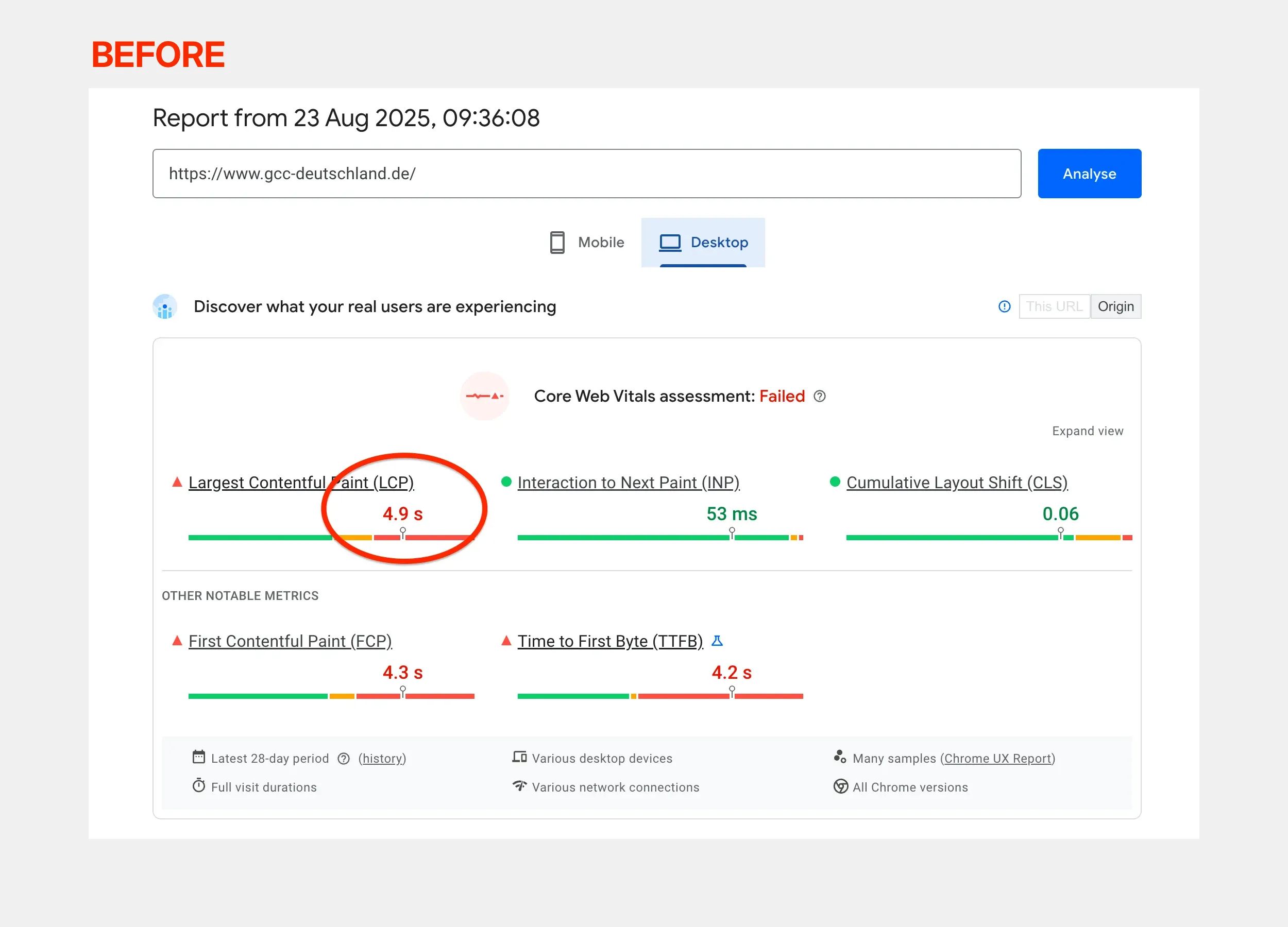
Core Web Vitals assessment for GCC Deutschland GmbH’s website had failed with their Largest Contentful Paint (LCP) clocking in at a concerning 4.9 seconds, far beyond Google’s recommended 2.5-second threshold.
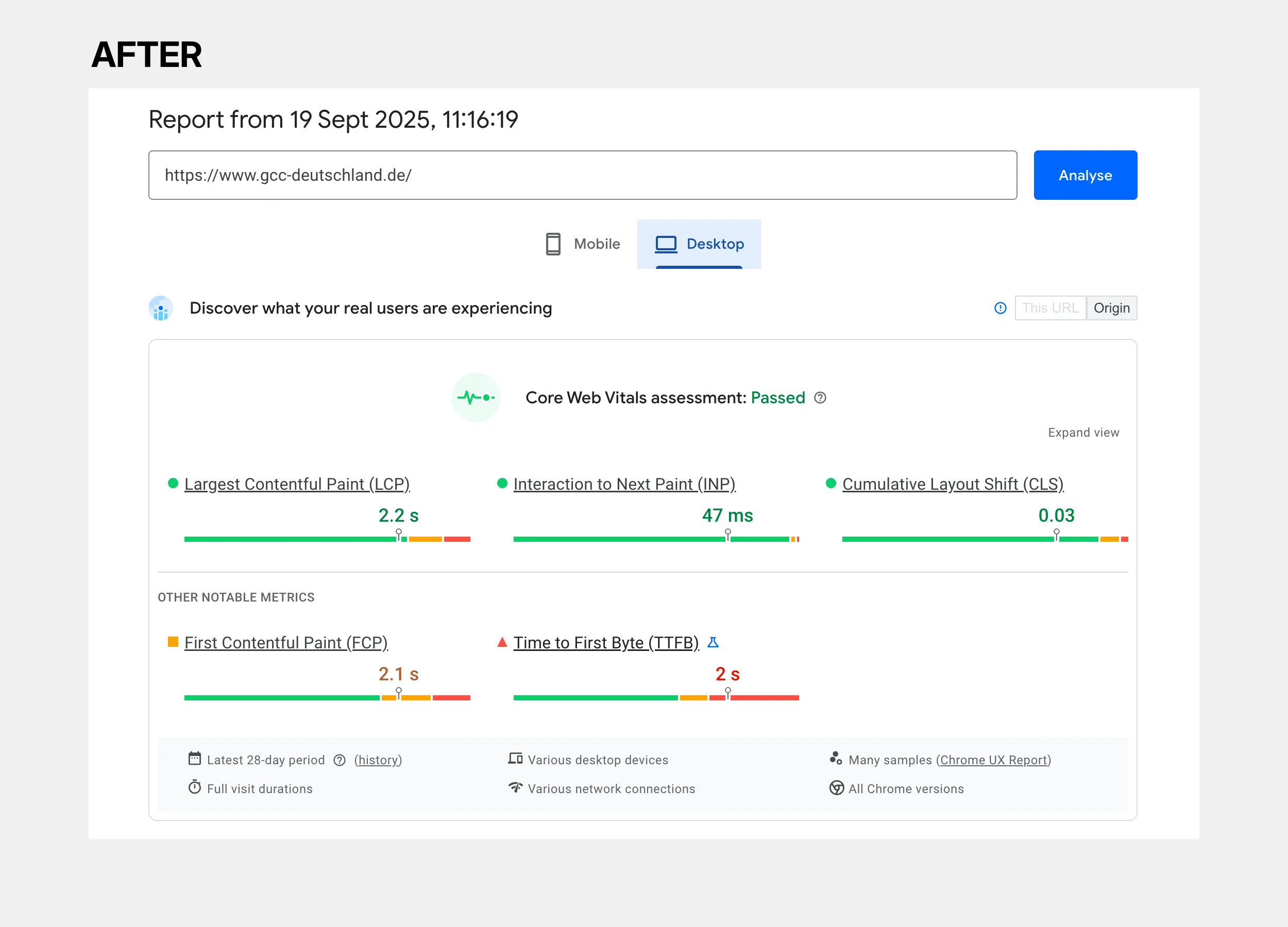
Our Core Web Vitals optimization for GCC Deutschland website helped them pass all of the Core Web Vitals tests and made their search rankings soar.
Project Details
- Client: Graphic Competence Center Deutschland GmbH
- Industry: E-commerce
- Website: https://www.gcc-deutschland.de/
- Platform: WordPress CMS, Woocommerce, and Oxygen page builder
- Project Duration: 6 weeks
- Performance Improvement: 55% faster loading, with LCP reduced from 4.9s to 2.2s for significantly better Core Web Vitals scores.
Business Impact
Prior to our work on their website GCC Deutschland was experiencing:
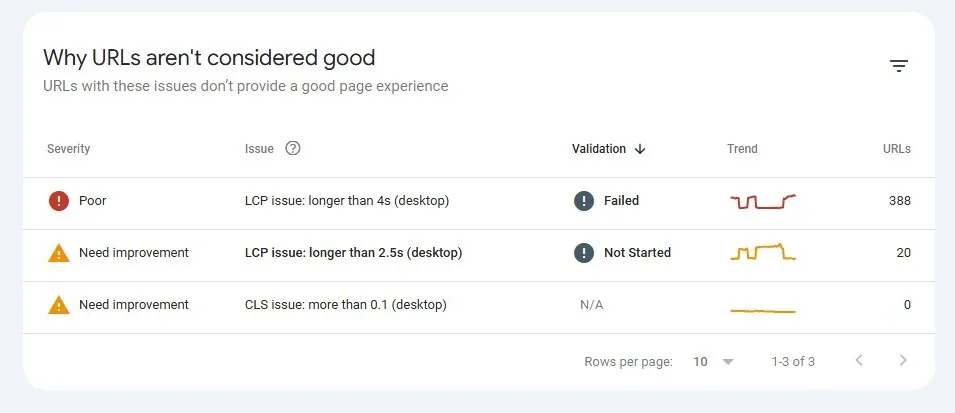
- Significant ranking drop in Google search results (388 URLs listed as Poor at their Google Search Console)
- High bounce rate due to slow-loading pages
- Lost revenue from abandoned checkout process
- Poor user experience affecting brand credibility and customer trust
Root Cause Analysis
GCC Deutschland’s WordPress website is built with WooCommerce as the core e-commerce plugin and Oxygen as the page builder.
Despite investing in optimization plugins like WP Rocket and later Seraphinite Accelerator, GCC Deutschland was unable to improve its LCP score. The root issue was a high TTFB, caused by the large number of logged-in customers browsing the site.
Since only a small portion of their customer base visited the site on mobile devices while logged out, their initial Core Web Vitals for mobile were already passing, with an excellent LCP score of 1.0 s.
Our technical audit revealed several critical performance bottlenecks:
- Plugin bloat (70+ active plugins)
- Slider revolution slide detected as LCP element
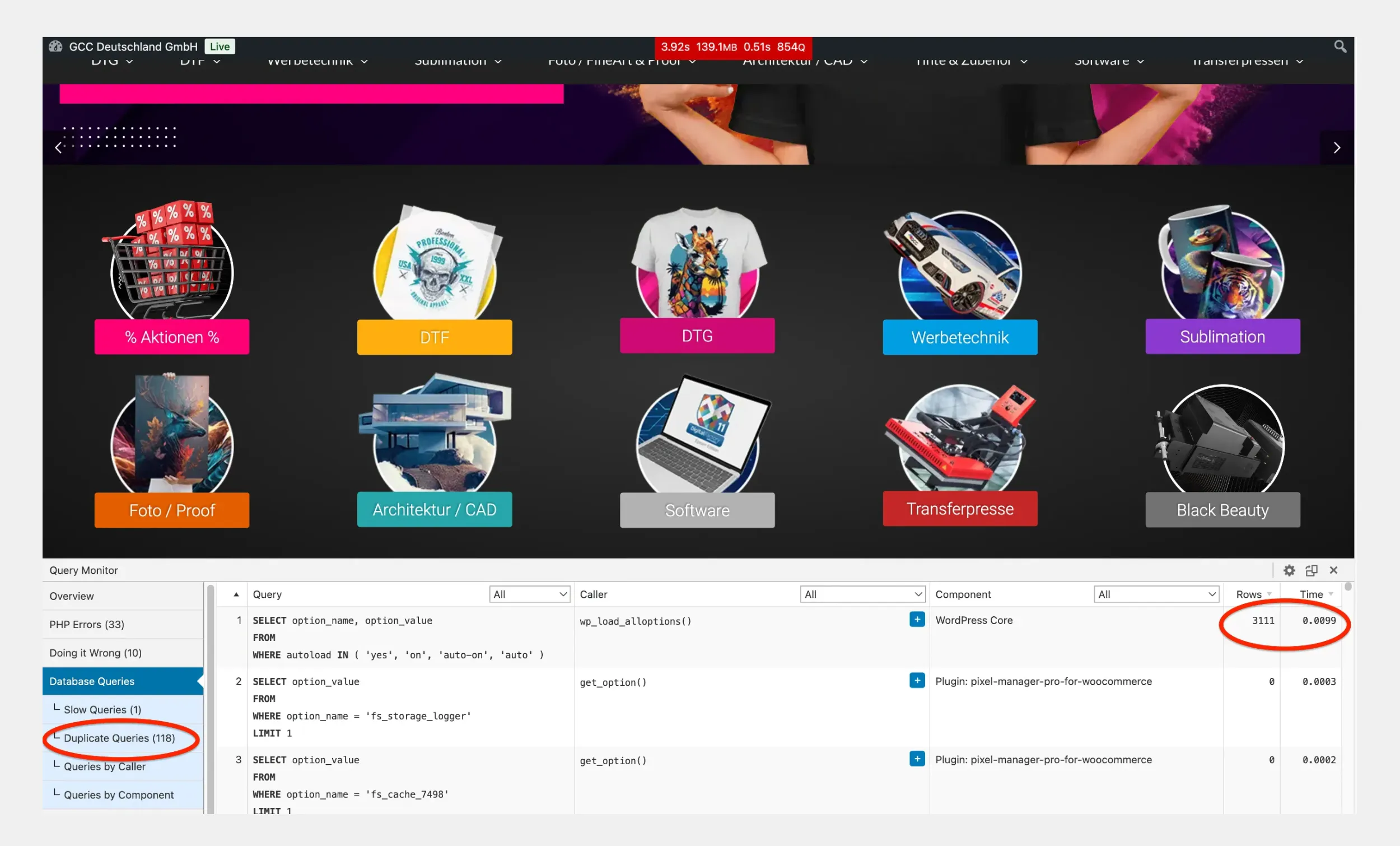
- Poor database performance (800+ queries, 118+ of which are duplicated)
- Cluttered database (3000+ autoloaded options)
- No high-performance keys added for MySQL tables
- No persistent object cache
- Disabled OPcache
Our Solution: Comprehensive Core Web Vitals Optimization
Phase 1: Foundation Optimization
Theme & Code Optimization
- Added high performance key indexes to critical database tables
- Optimized 277+ database tables and removed 200+ MB overhead
- Reduced plugin bloat by replacing them with light weight ones or code snippets
- Reduced 4,600Kb autoloaded options to under 2,000 KB
- Fixed PHP errors found in the custom plugin developed by their agency
- Fixed Premmerce plugin flushing WordPress cache with every page load, which helped with big performance gains
- Custom coded a plugin to regularly auto-clean completed scheduled actions that bloat the database
- Cached primary mega menu using transients to reduce queries by 200 on every page load
Hosting Improvements
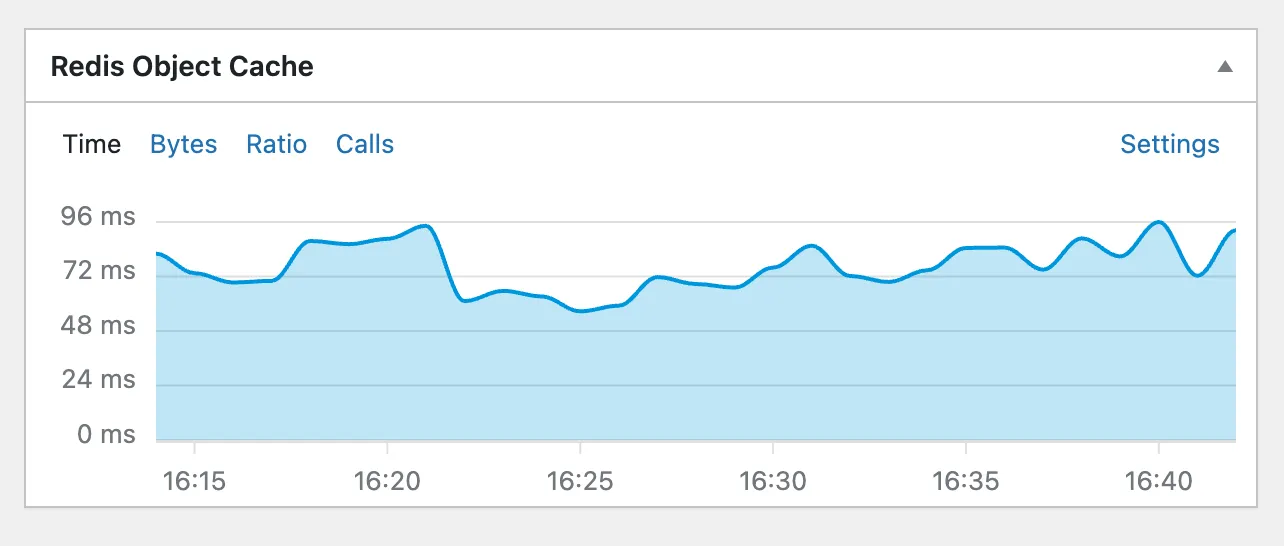
- Installed and configured Redis Object Cache
- Enabled and optimized OPcache values
Phase 2: Advanced Performance Tuning
Configured Seraphinite Accelerator with optimal settings
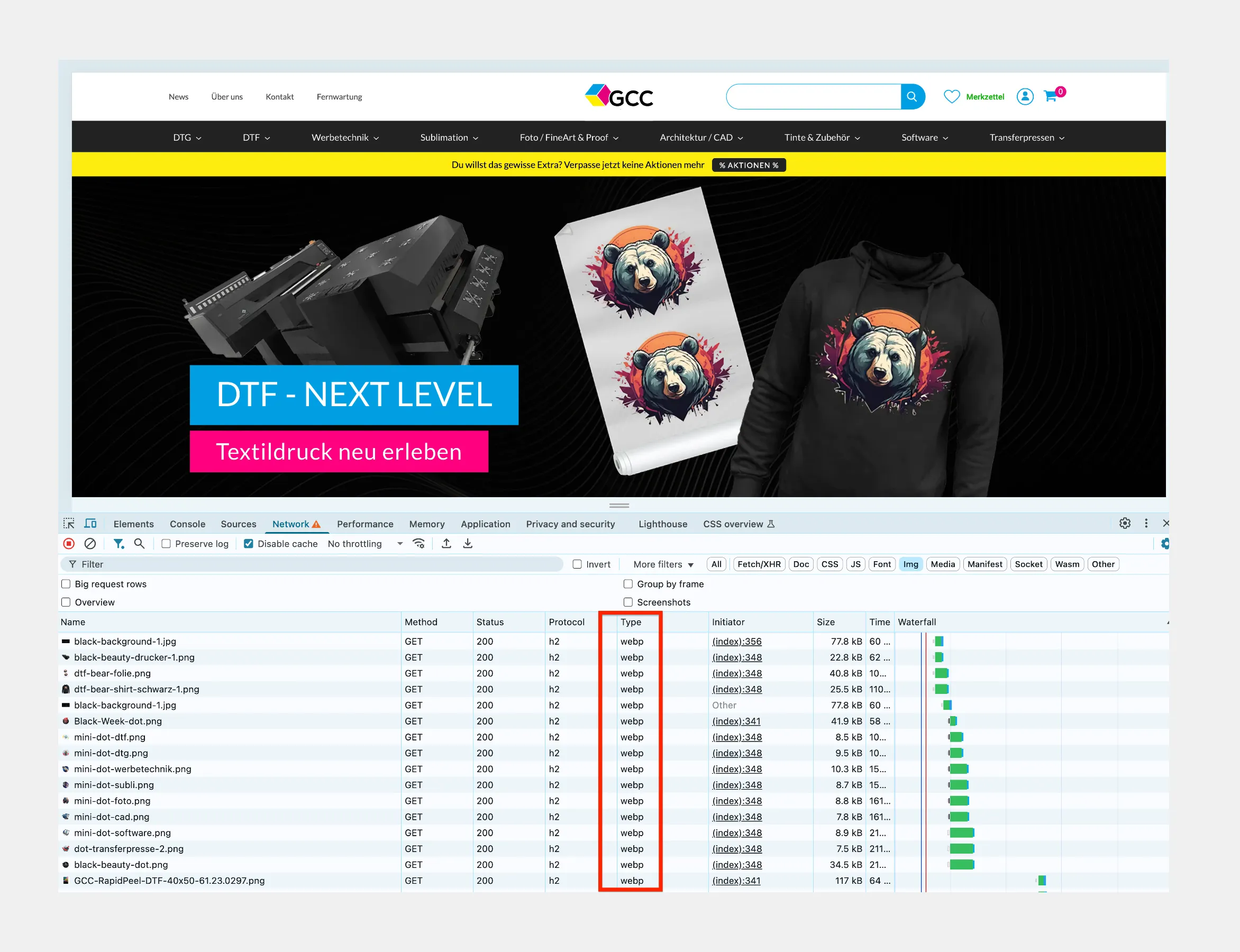
- Image optimization (webp images)
- Lazy loading for below-the-fold images
- Excluded LCP images from lazy loading and set fetch-priority=high
Caching Implementation
- Configured browser caching for static assets (images, fonts, css, and javascript files) with proper expiry headers using NGINX (Special thanks for hostpress.de team for their support during this implementation)
- Excluded analytics and tracking related URI parameters to avoid fragmentation
- Deferred non-critical JavaScript and delayed tracking scripts until first user interaction
- Inlined critical CSS and delayed non-critical CSS
- Implemented user caching except key pages (Cart, Checkout, and My Account)
- Custom coded a plugin to update cart item counts using AJAX so that we could full page cache product and category pages

Phase 3: Fine-Tuning & Monitoring
- Used RUM tools like CoreDash to monitor and optimize Core Web Vitals metrics
- Tested web performance using GTMetrix and DebugBear
- Reduced total blocking time by optimizing web fonts loading
- Configured Speculative Loading API to prefetch critical resources for anticipated page navigations, improving LCP scores across the user journey.
- Preloaded LCP elements on key pages
Results
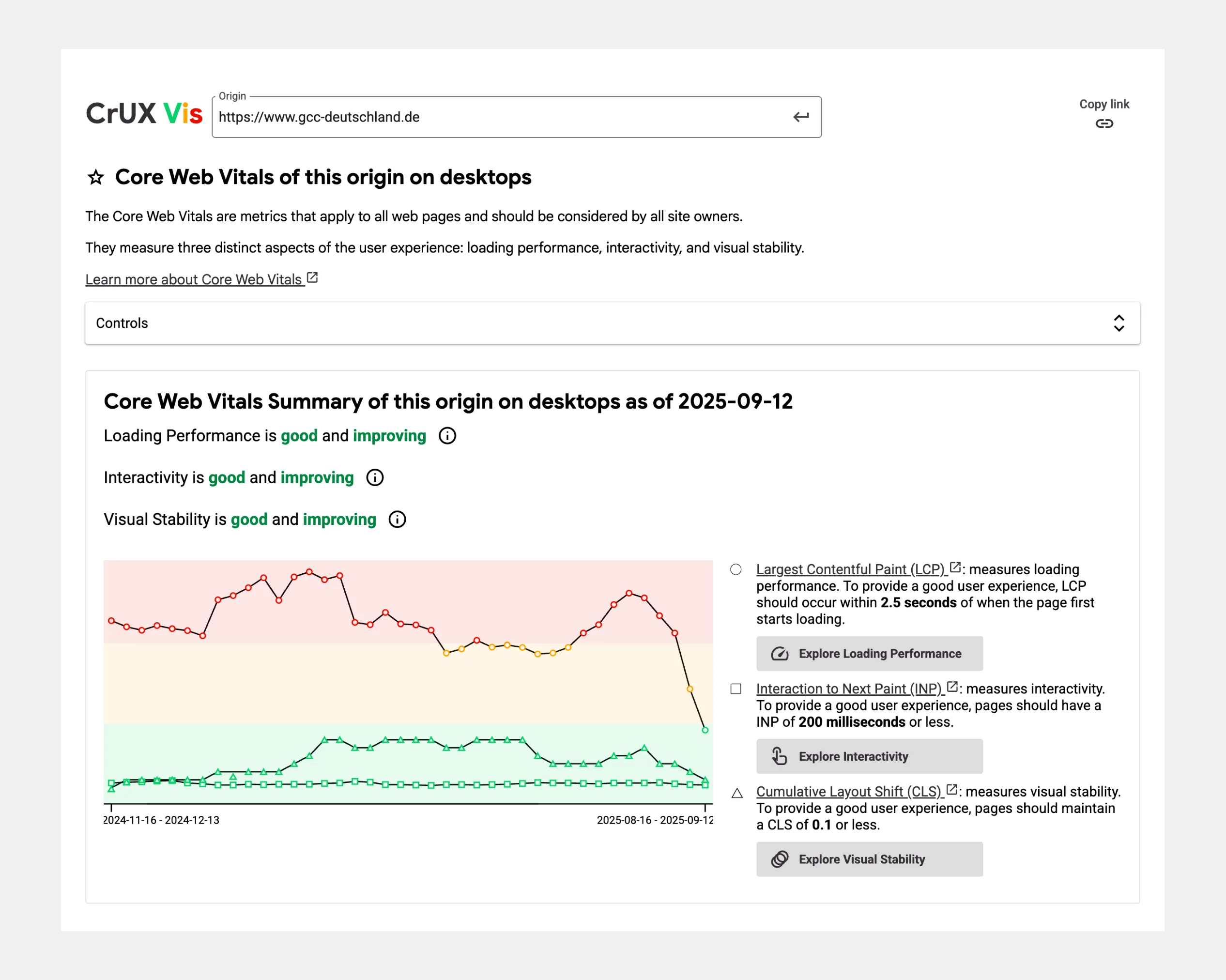
The Core Web Vitals results can be verified through CrUX Vis
As of early September 2025, GCC Deutschland passed all Core Web Vitals tests and all metrics are good and improving.
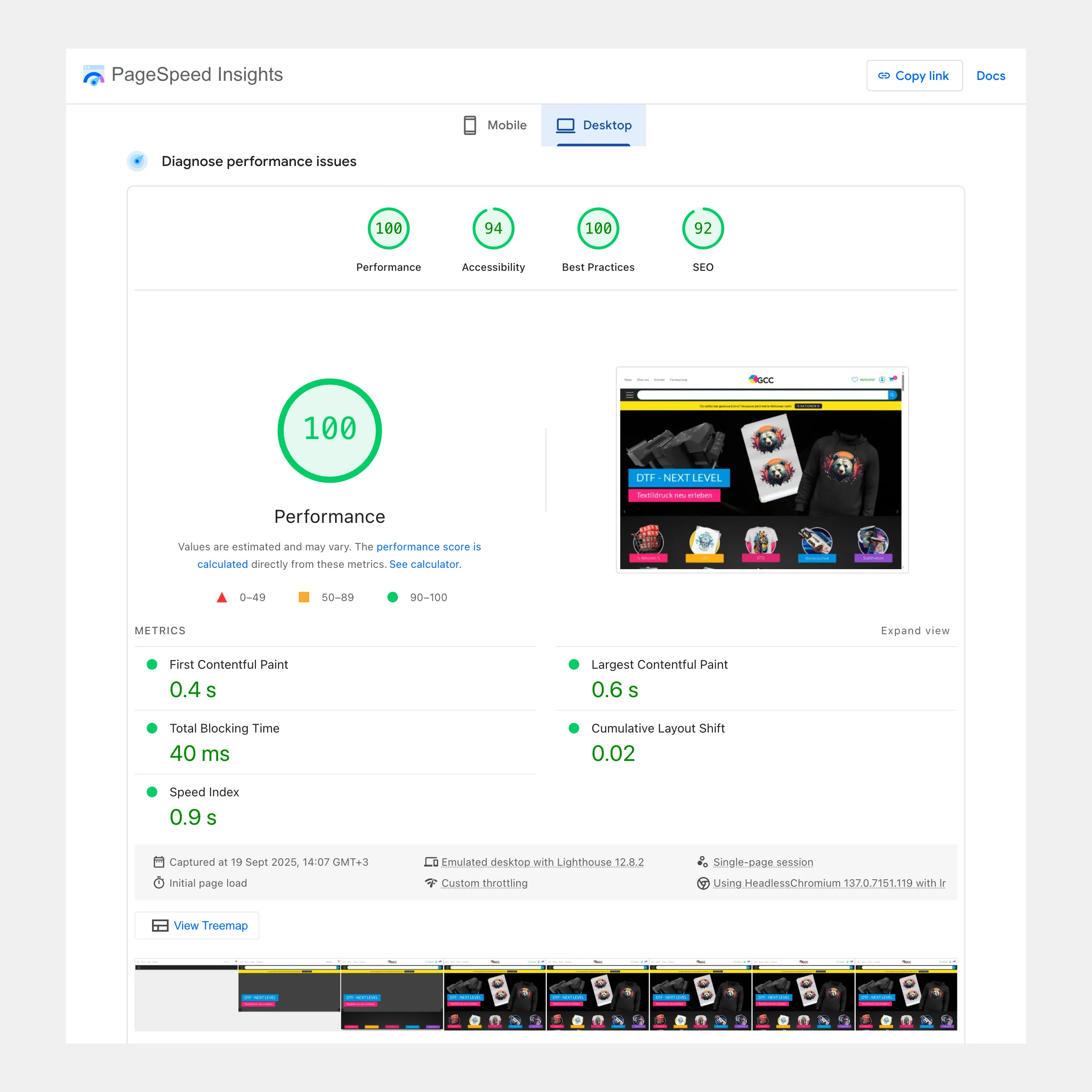
Pagespeed Insights also verifies this data with close to perfect Performance scores (98 for mobile and 100 for desktop)

More performance details and key metrics after optimization
- Largest Contentful Paint (LCP): 0.6 s
- Total Blocking Time (TBT): 40 ms
- Cumulative Layout Shift (CLS): 0.02
Key Takeaways
This case study highlights how a well-planned Core Web Vitals optimization can directly impact both user experience and business growth.
Technical expertise matters: A precise diagnosis uncovered performance bottlenecks (such as high TTFB from logged-in sessions, fragmented cache due to tracking querystrings, and heavy page builder overhead)
Holistic approach works: Improvements weren’t limited to caching configuration alone; optimizing hosting environment, reducing plugin bloat, better image handling, and improved code execution together delivered the biggest gains.
Ongoing maintenance is crucial: Core Web Vitals are not a one-time fix. Continuous monitoring and fine-tuning ensure that performance remains strong even as the website evolves.
ROI is significant: Faster load times and better Core Web Vitals scores translated into increased search rankings, higher user engagement, increased conversions, and more organic traffic – improvements that continue delivering measurable business value month after month.
Ready to Improve Your Core Web Vitals?
Is your WordPress site struggling with poor Core Web Vitals scores as well?
Our expert team can diagnose performance bottlenecks and implement proven solutions to boost your search rankings, reduce bounce rates, and increase conversions.
This case study showcases the real results our WordPress optimization experts deliver.
Contact us today to discuss your performance goals and start your optimization journey.
Update as of October 24th, 2025
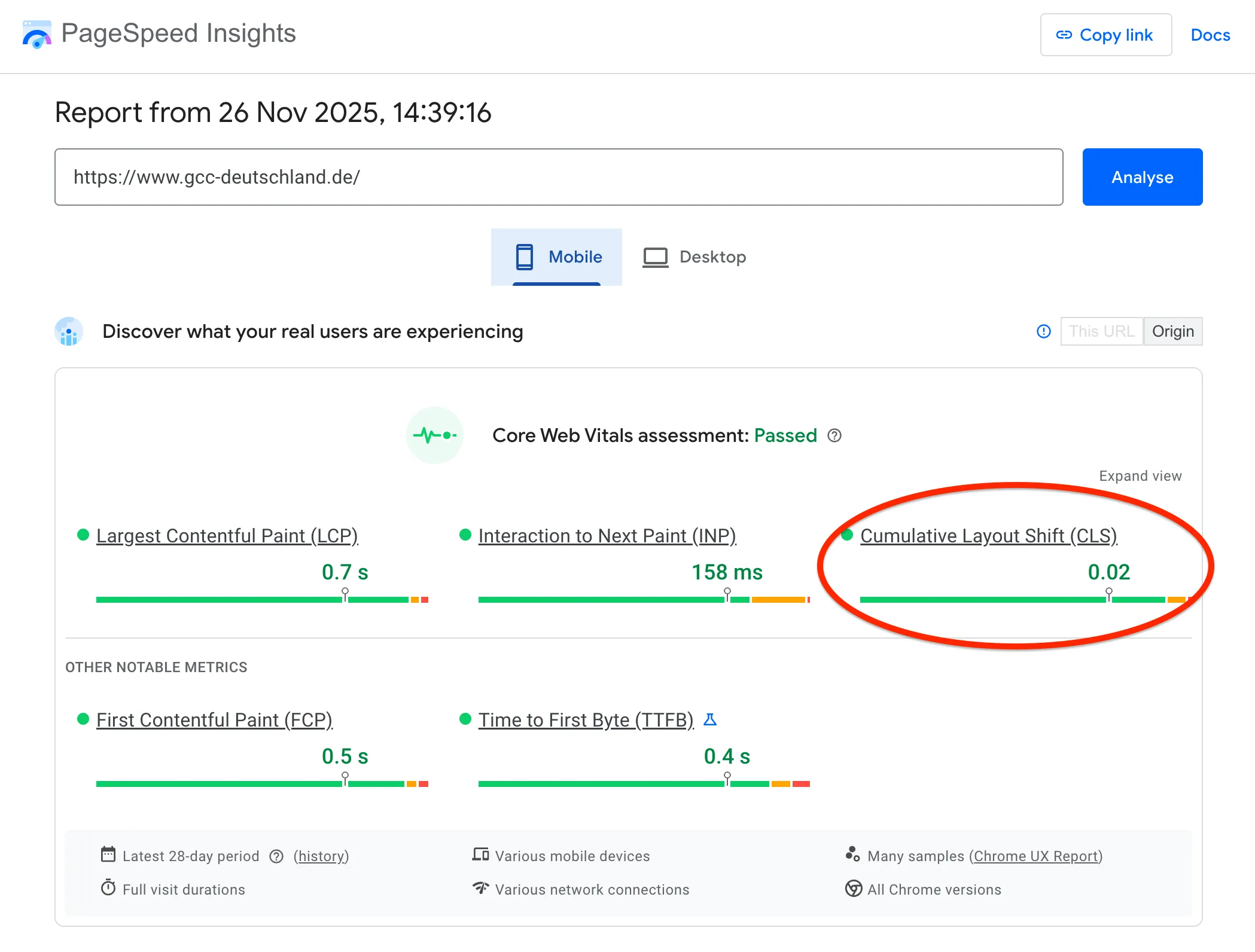
Client had a Core Web Vitals issue for mobile that was caused by a CLS (Cumulative Layout Shift) hitting 0.2 which caused mobile view to fail Core Web Vitals.
Having inspected what causes CLS, we found that an update done by their design agency was changing position of a section in header to fixed position based on the user’s scroll position.
This was causing that section to be removed from the document flow, shifting all the content below header.
We fixed that by adding necessary padding to the top most element to avoid the layout shift.
As of November 8th, 2025, CLS metric for mobile started dropping and we expect it to pass the Core Web Vitals in a few weeks when enough data has accumulated.
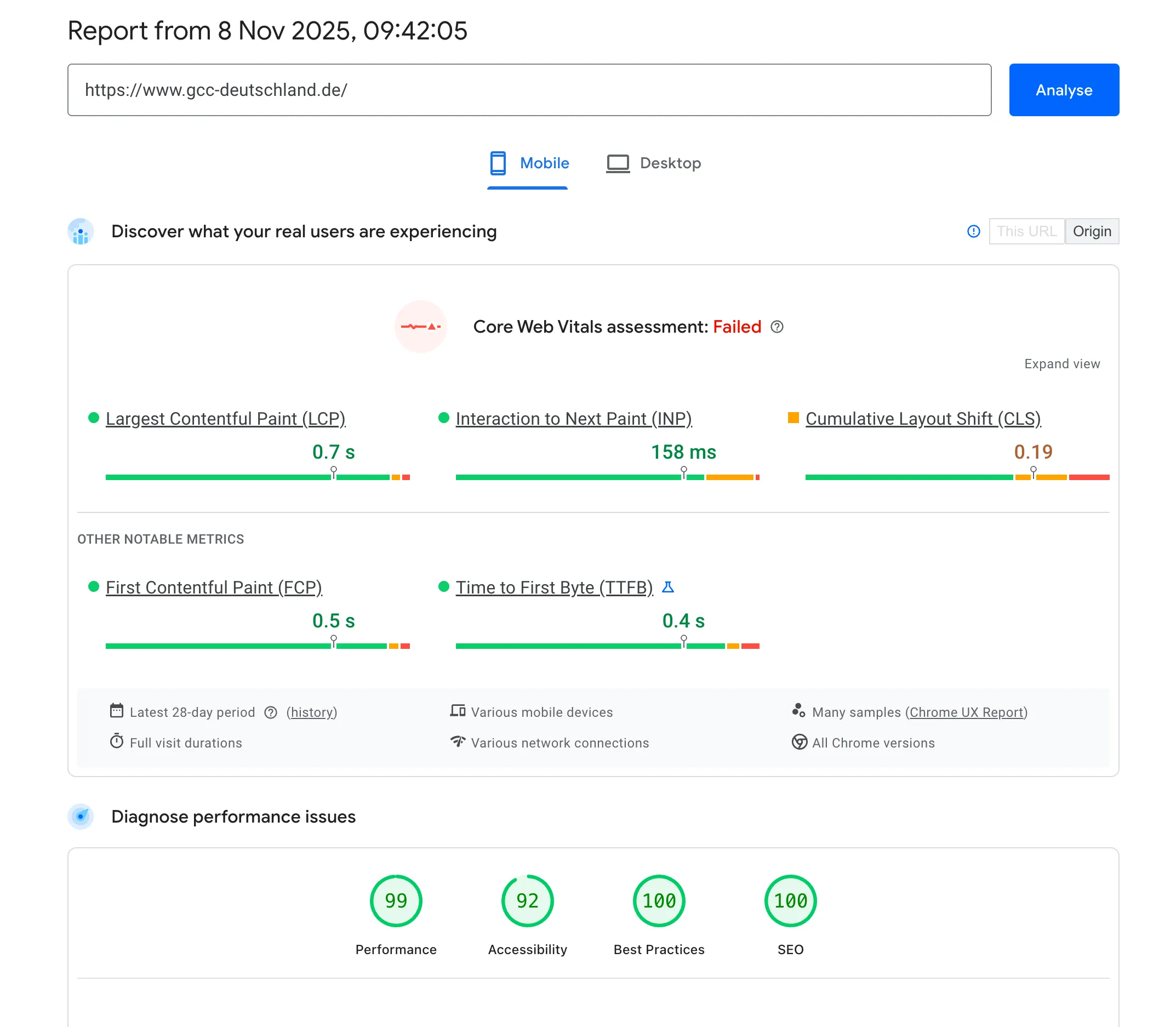
Furthermore, performance metrics for the desktop view has improved since our initial performance optimizations.
LCP has a solid improvement of 27%. It dropped from 2.2s to 1.6s
Similarly TTFB has dropped from 2s to 1.4s.

Update as of November 26th, 2025
CLS has significantly improved from 0.19 to 0.02 since our last update and all Core Web Vitals metrics pass the thresholds.